
Table of Contents
- Why Premium Guinea Pig Food Matters More Than You Think
- Guinea Pig Dietary Requirements: What Their Bodies Actually Need
- Signs of Vitamin C Deficiency in Guinea Pigs (And Why It Kills)
- How to Transition Guinea Pig Food Without Causing Stomach Upset
- Decoding Ingredient Labels: What's Hiding in Budget Pellets
- Life-Stage Nutrition: Pups, Adults, and Seniors Need Different Ratios
- Premium vs. Budget Guinea Pig Food: What You're Actually Paying For
- Frequently Asked Questions
Last Updated: September 16, 2026
Why Premium Guinea Pig Food Matters More Than You Think
Guinea pigs cannot make their own vitamin C. That single biological fact is why premium guinea pig food matters more than most owners realize: the wrong pellet can quietly starve a small animal of the one nutrient its body cannot manufacture. At Critter Love® LLC, we formulate small pet diets around that reality rather than around price per pound.
Here's the part most feeding guides skip. A guinea pig's digestive system runs on fiber almost continuously, and its teeth never stop growing. Cheap food cuts corners on both. The result shows up months later as weight loss, drooling, or a guinea pig that stops eating entirely. Below, we'll break down what their bodies actually need, how to read a label without a nutrition degree, and how to switch foods without triggering a stomach upset.
Guinea Pig Dietary Requirements: What Their Bodies Actually Need
A guinea pig's daily diet should be roughly 80% grass hay, about 15% fresh vegetables, and only 5% pellets. Pellets are a supplement, not a meal, and treating them as the main course is the most common feeding mistake we see. But the percentages only make sense once you understand what each part is doing inside the animal.
The 80/20 Rule: Hay First, Pellets Second
Unlimited grass hay does two jobs at once. It wears down the molars and incisors that grow continuously throughout a guinea pig's life, and it supplies the long-strand roughage that keeps the digestive tract moving.
Here's the mechanism most guides skip. A guinea pig's gut is a continuous-flow system, not a storage tank. The cecum, a fermentation chamber at the junction of the small and large intestine, depends on a steady stream of long-strand fiber to feed the beneficial bacteria that break down plant matter. When hay intake drops, that bacterial population shifts, gas builds up, and the muscular waves that push contents through the tract slow down. The clinical name is gastrointestinal stasis, and it is a veterinary emergency, not a wait-and-see problem. A guinea pig that stops producing droppings for 12 hours needs to be seen the same day.
Pellets fill nutritional gaps the hay can't cover, particularly vitamins and trace minerals. They should never replace hay. Think of pellets as a multivitamin with calories, not as the meal itself.
The Calcium-to-Phosphorus Ratio
The calcium-to-phosphorus ratio is the number most owners never check, and it matters most for young, pregnant, and nursing guinea pigs, who need more calcium than adults to build bone and support milk production. The rest of the time, excess calcium is excreted through the urinary tract, and too much of it contributes to bladder sludge and stones, a painful, recurring problem that often requires surgical intervention.
The target most practitioners aim for in a maintenance diet is a calcium-to-phosphorus ratio between roughly 1.5:1 and 2:1.
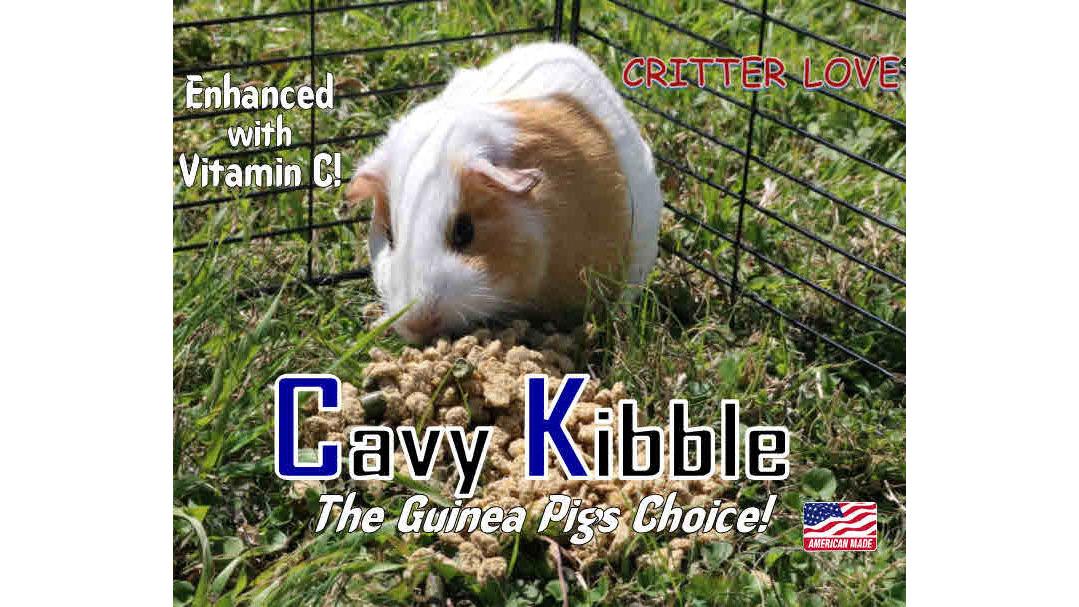
Critter Love® Cavy Kibble — Enhanced →
Signs of Vitamin C Deficiency in Guinea Pigs (And Why It Kills)
Vitamin C deficiency in guinea pigs develops fast because they cannot synthesize ascorbic acid on their own. Unlike rabbits and most other mammals, guinea pigs depend entirely on what they eat for this nutrient, and a shortage can show up within a couple of weeks.
Early Warning Signs Most Owners Miss
The first signs are easy to dismiss as personality changes:
- Rough, dull coat or patchy fur
- Reluctance to move, or a hunched posture
- Drooling and difficulty chewing, which points to dental pain
- Slow wound healing and a general loss of appetite
- Swollen or tender joints in more advanced cases
How to Transition Guinea Pig Food Without Causing Stomach Upset
Switching foods too fast is the fastest way to cause diarrhea, which is dangerous in small animals. A proper food transition takes 7 to 10 days, mixing old and new pellets in shifting proportions so the gut bacteria have time to adjust.
Use this schedule:
| Day | Old Food | New Food |
|---|---|---|
| 1-2 | 75% | 25% |
| 3-4 | 50% | 50% |
| 5-6 | 25% | 75% |
| 7-10 | 0% | 100% |
Decoding Ingredient Labels: What's Hiding in Budget Pellets
Ingredient lists are ordered by weight, so the first three items tell you almost everything. A quality guinea pig pellet leads with forage ingredients and states a guaranteed vitamin C level on the label. Budget pellets often lead with fillers and rely on the vitamin C naturally present in the ingredients, which degrades in storage.
Watch for these red flags:
- Artificial preservatives used to extend shelf life at the expense of nutrient stability
- Added sugars or molasses that boost palatability while adding empty calories
- Vague terms like "grain products" or "forage products" that hide what's actually in the bag
- No guaranteed analysis for vitamin C, which usually means nobody tested it
Life-Stage Nutrition: Pups, Adults, and Seniors Need Different Ratios
A single bag of pellets is not the right answer for every guinea pig in the house. Pups, pregnant and nursing sows, adults, and seniors have genuinely different needs, and feeding them all the same formula means at least one of them is getting the wrong balance.
Premium vs. Budget Guinea Pig Food: What You're Actually Paying For
The real difference between a premium guinea pig food and a budget one is not the price on the bag. It is what the ingredient list and guaranteed analysis tell you about how the food was built, and what they leave out. Learning to read those two panels is the single most useful skill an owner can develop, because it turns a marketing claim into a verifiable fact.
Critter Love® Cavy Kibble — Enhanced →
How to Read the Ingredient List Like a Formulator
Ingredient lists are ordered by weight before processing, so the first three items tell you almost everything. A quality guinea pig pellet leads with forage ingredients, things like extruded barley, soybean meal, and extruded oats, and states a guaranteed vitamin C level on the label. Budget pellets often lead with fillers and rely on the vitamin C naturally present in the ingredients, which degrades in storage.
Watch for these red flags:
- Artificial preservatives used to extend shelf life at the expense of nutrient stability
- Added sugars or molasses that boost palatability while adding empty calories
- Vague terms like "grain products" or "forage products" that hide what's actually in the bag
- No guaranteed analysis for vitamin C, which usually means nobody tested it
What the Guaranteed Analysis Actually Guarantees
The guaranteed analysis is the legal panel that states minimum and maximum levels for protein, fat, fiber, moisture, and, on a properly formulated guinea pig food, vitamin C. If vitamin C is not on that panel, the manufacturer is not guaranteeing it survives to the day you open the bag. Vitamin C is unstable: it degrades with heat, light, moisture, and time.
The Consistency Question
Premium food is also built for batch-to-batch consistency. When a formula uses named ingredients and a fixed guaranteed analysis, the bag you buy in six months matches the bag you buy today. Budget producers reformulate around commodity prices, which means the food can change without the label changing much. For a guinea pig with a sensitive gut, that inconsistency is its own risk.
Frequently Asked Questions
What is the best quality guinea pig food?
The best guinea pig food starts with unlimited fresh timothy hay, which should make up about 80% of the diet. Pellets come second: look for a formula with stabilized vitamin C, a calcium-to-phosphorus ratio between 1.5:1 and 2:1, and no artificial preservatives. Critter Love® Cavy Kibble is enhanced with vitamin C and made with fiber-rich ingredients like extruded barley, soybean meal, and extruded oats. Fresh vegetables round out the diet, but hay is non-negotiable for dental and digestive health.
What are the signs of vitamin C deficiency in guinea pigs?
Guinea pigs cannot make their own vitamin C, so deficiency signs appear within weeks. Watch for rough or dull coat, reduced appetite, weight loss, reluctance to move, swollen joints, and slow wound healing. Advanced deficiency causes drooling, tooth problems (malocclusion), and hind leg weakness. Because these signs overlap with other illnesses, any change in eating or mobility warrants a vet visit. A diet with stabilized vitamin C, like Critter Love® Cavy Kibble, helps prevent deficiency before symptoms start.
How do you transition a guinea pig to a higher-quality food brand?
Switch gradually over 7 to 10 days to avoid digestive upset. Start with 75% old food and 25% new food for three days. Move to 50/50 for three days, then 25% old and 75% new for three days. Finish with 100% new food. Watch droppings and appetite daily. If you see soft stools or your guinea pig stops eating, slow the transition and hold at the current ratio for a few extra days. Never remove hay during the transition.
What ingredients should be avoided in low-quality guinea pig pellets?
Skip pellets with artificial preservatives like BHA, BHT, or ethoxyquin, plus added sugars, molasses, and dried fruit. These add calories without nutrition and can upset gut motility. Also avoid mixes with seeds, nuts, or colored kibble pieces, since guinea pigs selectively eat the sugary bits and leave the fortified pellets behind. Look for a short ingredient list built on hay or extruded grains, with a guaranteed vitamin C level listed on the package.


