
Table of Contents
- Quick Comparison: Best Staple Diet for Captive Gliders
- 1. Critter Love® Complete: The Most Tested Staple Diet
- 2. Critter Love® Plus: For Coat, Weight, and Odor Support
- 3. Critter Love® Breeders Formula: Staple Diet for Breeding Gliders
- 4. Sample Pack and Combo Pack: Trying a Staple Diet Before Committing
- What Do Sugar Gliders Eat Daily?
- The BML Diet for Sugar Gliders and Other Homemade Plans
- Sugar Glider Staple Diet Recipes and Preparation
- Frequently Asked Questions
Last Updated: October 5, 2026
Quick Comparison: Best Staple Diet for Captive Gliders
The best staple diet for captive gliders is laboratory tested, veterinarian approved, and formulated specifically for sugar gliders rather than adapted from another animal's needs. At Critter Love® LLC, we built our feeding line around that standard, and this guide compares our five staple options.
Sugar gliders are small, high-energy marsupials with demanding nutritional needs. A staple diet is the protein-and-nutrient base of their daily meals, fed alongside fresh produce. Get it wrong and you'll see it in their coat, weight, and energy within weeks.
Here's the short version:
Product |
Price |
Best For |
Prep |
|---|---|---|---|
$20.55 |
Most gliders, everyday feeding |
Just add water |
|
Critter Love® Plus |
$18.45 |
Coat, weight, and odor support |
Add bee pollen, egg, honey |
Breeders Formula |
$41.75 |
Breeding pairs and joeys |
Just add water |
Sample Pack |
$4.15 |
First-time buyers testing the diet |
Varies by product |
Combo Pack |
$49.75 |
Complete plus fruity kibble |
Just add water |
Below, we break down each option, then cover daily feeding, how the BML diet compares to a prepared staple, and how to prepare a batch.

1. Critter Love® Complete: The Most Tested Staple Diet
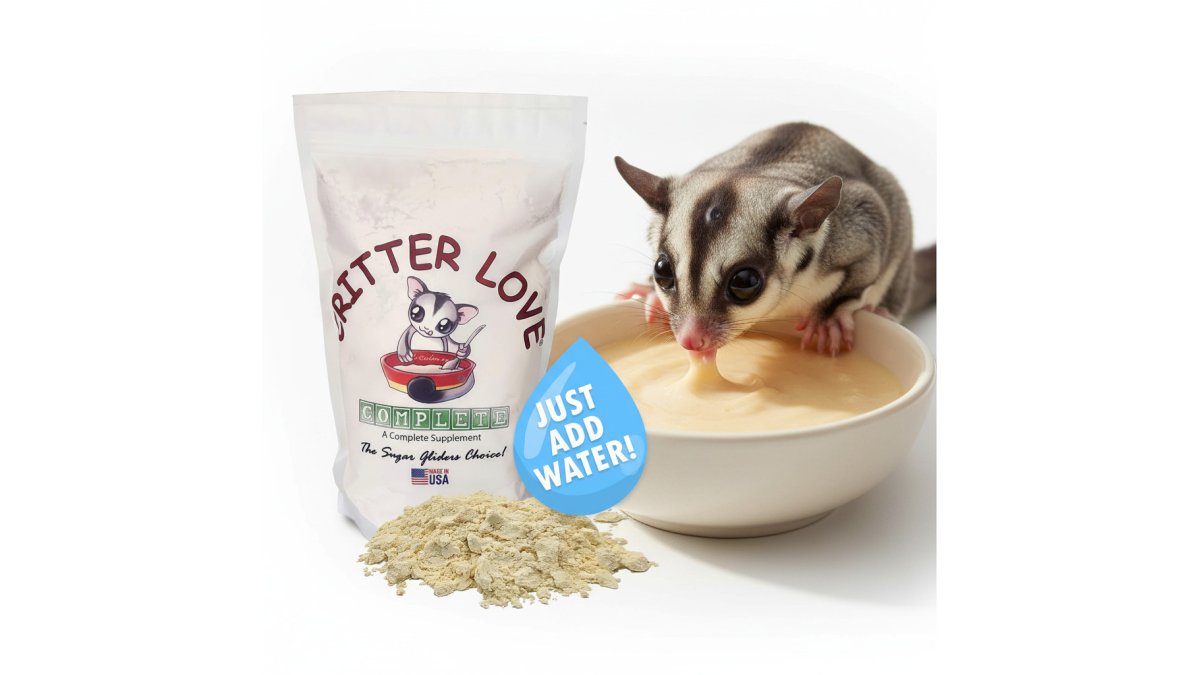
Our top pick for most households is Critter Love® Complete, the most extensively laboratory tested staple on the market today for captive bred sugar gliders. It is scientifically formulated and veterinarian approved, carrying protein, calcium, vitamins, minerals, Omega 3, Omega 6, and amino acids in one scoop.
Preparation is simple: add water, stir, serve. No cooking, blending, or guessing at ratios. Consistency matters more than variety in the staple portion, switching brands every few weeks shows up as loose stool and food refusal.
At $20.55, it is the entry point we recommend to nearly every new owner. Ten percent of Critter Love Profits go to Sugar Glider Research!
2. Critter Love® Plus: For Coat, Weight, and Odor Support
If your glider's coat looks dull, their weight drifts, or the cage smells stronger than it should, Critter Love® Plus is the formula we point people toward. It is the premium staple diet trusted by owners and recommended by veterinarians, built to support coat health, weight control, odor reduction, and overall wellness.
The formula is calcium fortified for bone development and includes Omega-6 and Omega-3 fatty acids from flaxseed oil, made in small batches for freshness. Prep takes a few extra minutes compared to Complete: add the included bee pollen plus scrambled eggs, raw honey, and water.
3. Critter Love® Breeders Formula: Staple Diet for Breeding Gliders
Breeding colonies have different demands than a single pet glider, and Critter Love® Breeders Formula is formulated for exactly that, supporting reproductive health and joey development while delivering peak nutrition to the whole colony.
Critter Love® Complete Sugar Glider Food →

Like Complete, it's a just-add-water product, so you're not juggling separate recipes for mom, dad, and joeys, single-bowl simplicity is the real advantage in a breeding setup.
Available in 1lb, 2lb, 5lb, and 10lb sizes.
4. Sample Pack and Combo Pack: Trying a Staple Diet Before Committing
Not sure your gliders will accept a new staple? Start with the Critter Love® Sample Pack. For $4.15 you get a Complete sample, a Plus sample, and the bee pollen needed to make your first batch of Plus, a small trial without a full-size commitment.
The Combo Pack at $49.75 pairs 1 lb of Complete with 1 lb of fruity kibble. The kibble emulates a natural sugar glider diet with toasted grains and multiple protein sources, and the crunch helps with dental hygiene.

What Do Sugar Gliders Eat Daily?
A sugar glider's daily diet is roughly one part staple to one part fresh produce, fed once in the evening as the animal wakes. The staple carries the protein, calcium, and micronutrients; the produce supplies fiber, moisture, and variety. The actual number behind "one part" is where feeding problems start.

A measurable daily plate, per glider
- Staple: about 1 tablespoon of prepared staple, mixed to a thick spoonable paste
- Fruit: 1-2 small cubes (roughly 1/2 inch each) of apple, pear, melon, or papaya
- Vegetables: about 1 tablespoon total of dark leafy greens, squash, green beans, or sweet potato
- Protein treat: 2-3 small insects, a thumbnail of hard-boiled egg, or one small nut, two or three evenings a week, not every night
The calcium-to-phosphorus ratio is the number that matters most
Captive gliders are prone to nutritional secondary hyperparathyroidism, a metabolic bone problem that develops when the diet is phosphorus-heavy relative to calcium.
Feeding schedule and cleanup
- Evening (around dusk): serve the staple first, then arrange produce around it. Gliders eat the staple as the main dish and graze the produce afterward; mixing everything together encourages them to pick out the sweet pieces and leave the rest.
- Morning: remove uneaten produce before it spoils, along with staple residue left past a few hours.
- Water: available at all times in a shallow dish or bottle. Gliders are messy eaters and drop food constantly.
What to watch, week to week
Weigh each glider monthly on a small kitchen scale and write the number down. A stable adult weight, a full coat, bright eyes, and consistent stool are the four signals the daily plate is working. Gradual weight loss, a dull coat, or loose stool persisting more than a few days are the earliest signs something needs attention. Bring the weight log to your exotic-animal veterinarian rather than guessing.
The BML Diet for Sugar Gliders and Other Homemade Plans
The BML diet for sugar gliders is one of the best-known homemade plans, built around blended eggs, honey, apple juice concentrate, and a calcium supplement. It has a devoted following, and plenty of keepers have raised healthy gliders on it. But BML is not the only homemade option, and the comparison most guides skip is how the major homemade plans stack up against each other, and against a prepared staple.
Side-by-side: three common homemade approaches
Plan |
Core ingredients |
Prep effort |
Main trade-off |
|---|---|---|---|
BML |
Blended eggs, honey, apple juice concentrate, calcium supplement, plus a leadbeater-style mix |
Shopping trip, blending session, portioning every 1-2 weeks |
Calcium depends entirely on you measuring the supplement every batch |
Leadbeater-style mix |
Warm water, honey, eggs, high-protein baby cereal, vitamin/mineral supplement |
Similar to BML; requires a supplement you source separately |
Supplement sourcing and freshness vary; ratios shift if you substitute cereal |
Simplified egg-and-honey base |
Scrambled egg, honey, a prepared formula or cereal base, calcium source |
Shorter than BML but still hands-on |
Fewer ingredients means less margin for error, one skipped component unbalances the ratio |
Where homemade plans get tricky
The other issue is time. A homemade staple typically means a shopping trip, a blending session, and portioning, repeated every couple of weeks. That is fine if you enjoy it, but a problem if you travel, share feeding duties, or keep more than a couple of gliders.
Where a prepared staple fits
A prepared staple removes the measuring variable. The formula is mixed the same way every batch, the calcium-to-phosphorus ratio is already set, and the only decision left is how much water to add. Our Natural Feeding Manual walks through preparation, servings, and the reasoning behind the method so you are not piecing together advice from a dozen forum threads.
Transitioning a picky or refusing glider
- Evenings 1-3: 3/4 old staple, 1/4 new staple, mixed together
- Evenings 4-6: 1/2 old, 1/2 new
- Evenings 7-9: 1/4 old, 3/4 new
- Evening 10 onward: all new staple
Sugar Glider Staple Diet Recipes and Preparation
Getting a staple diet recipe right comes down to accurate portions, correct water ratio, and proper storage.
Critter Love® Complete Sugar Glider Food →
For Complete or Breeders Formula:
- Scoop the recommended amount into a clean bowl
- Add water gradually and stir until it reaches a thick, spoonable paste
- Portion into ice cube trays and freeze what you won't use within a few days
- Thaw one portion per glider and serve in the evening
For Plus:
- Mix the formula with the included bee pollen
- Add scrambled egg, raw honey, and water
- Stir until fully combined with no dry pockets
Serving it with fresh produce: plate the staple first, then add the fruit and vegetables around it rather than mixed in. Gliders eat the staple as the main dish, then graze the produce; mixing everything together encourages them to pick out the sweet pieces and leave the rest.
Picking a staple diet for captive gliders comes down to matching the formula to your situation: everyday feeding, coat and weight support, or a breeding colony. Guessing at portions and ratios is where most feeding problems start.
Critter Love® LLC formulates every staple with licensed veterinarians and exotic animal nutritionists, laboratory tests each batch, and ships within 24 business hours. Our Complete, Plus, and Breeders Formula cover the three most common feeding setups, and the Sample Pack lets you test the diet before committing. Get started with Critter Love® and give your gliders the nutrition they deserve.
Frequently Asked Questions
What is the best diet for sugar gliders in captivity?
The best staple diet for captive gliders combines a protein-based staple with fresh produce. Critter Love Complete is the most extensively laboratory tested staple for captive-bred sugar gliders and contains protein, calcium, vitamins, minerals, Omega 3 and 6, and amino acids. Pair it with a freeze-dried salad such as Harvest Blend, which is made with no artificial preservatives, colors, or additives, for a balanced daily meal.
What foods are toxic to sugar gliders?
When in doubt, stick to a trusted staple diet plus glider-safe produce.
What should sugar gliders eat every day?
A daily sugar glider meal has two parts: a staple diet and fresh produce. Prepare the staple according to its instructions, then add a salad of fruit, vegetables, and leafy greens. Critter Love Complete requires only water, while Critter Love Plus needs bee pollen, scrambled eggs, raw honey, and water. Serve the same time each evening, when gliders naturally wake and feed.
Do sugar gliders need a calcium supplement?
A calcium-fortified staple removes most of the guesswork. Critter Love Plus and Critter Love Complete are both calcium fortified, and Plus also contains Omega-6 and Omega-3 fatty acids including flaxseed oil.
Can sugar gliders eat the same staple diet every day?
Yes, a staple diet is designed to be fed daily, but variety comes from the fresh side of the bowl. Critter Love Complete pairs with any Critter Love freeze-dried salad, which makes daily rotation simple.


