
Last Updated: October 24, 2026
Quick Summary
Sugar glider toys are essential enrichment that encourages natural climbing, swinging, foraging, and exploring while preventing boredom and reducing stress. Safe options use pet-safe materials with no small detachable parts, and rotating two to three toys weekly keeps them novel and engaging. Foraging toys that make food a task offer the highest-value mental stimulation.
- Safe toys share four traits: pet-safe materials, no small chewable parts, appropriate size and weight, and durability.
- Keep two to three toys in the cage at a time and rotate them weekly to reset novelty.
- Foraging toys combine movement, problem-solving, and food, making them the highest-value enrichment.
- Inspect every toy weekly and retire it at the first sign of wear, not failure.
- Shy gliders do best with simple hanging toys and low-effort foraging stations near their sleeping spot.
Table of Contents
- Why Sugar Glider Toys Are Essential, Not Optional
- What Makes Safe Toys for Sugar Gliders
- Sugar Glider Foraging Toys and Food-Dispensing Play
- Critter Love Sugar Glider Toys: What We Make and Why
- DIY Sugar Glider Toys You Can Build at Home
- Sugar Glider Toy Rotation: A Simple Weekly Plan
- Cleaning, Replacement, and Matching Toys to Temperament
- Frequently Asked Questions
Why Sugar Glider Toys Are Essential, Not Optional
Sugar glider toys are not accessories you add once the cage is set up.
The case for enrichment rests on what these animals are built to do.
What fills the gap? Boredom behaviors. Over-grooming, pacing, cage bar chewing, and a glider that bolts when you reach in. None of these are personality flaws.
Here is the part most new owners get wrong: they buy one toy, hang it in the corner, and assume the job is done. Gliders habituate fast.
What Makes Safe Toys for Sugar Gliders
Safe toys for sugar gliders share four traits: pet-safe materials, no small parts a glider can chew loose and swallow, a size and weight that suits a small climbing animal, and enough durability to survive daily tugging. Everything else, color, shape, jingle, is decoration on top of that foundation.
Materials to Look For and Avoid
The materials question is where most toy injuries start. A glider's teeth are made for stripping bark and opening seed pods, so anything soft enough to shred will get shredded.
- Safe: untreated seagrass, natural woven fibers, hard untreated wood, stainless steel hardware, solid plastic links, and tightly attached beads.
- Avoid: loose string and thread, fraying rope, soft rubber that tears into chunks, exposed wire, and any metal that can bend or flake.
A common mistake is assuming that because a toy is sold in a pet store, it is glider-safe. Bird toys are a useful starting point because they are built for beaks that destroy things, but check the hardware. Split rings, small bells with open edges, and lead-weighted bases are all things a glider can work loose.
The Safety Checklist Before Anything Goes in the Cage
Run every new toy, bought or homemade, through this list before it goes in:
- No part smaller than your glider's head can detach with normal chewing
- All chain links and rings are closed and cannot open under tension
- No loose string, thread, or fraying fiber anywhere on the toy
- No exposed wire, sharp metal edges, or flaking coating
- The toy hangs securely and cannot fall or swing into a heat source
- No adhesive, paint, or dye that is not explicitly pet-safe
- The toy is inspected weekly for wear and replaced once it starts breaking down
Sugar Glider Foraging Toys and Food-Dispensing Play
Foraging toys are the highest-value enrichment you can give a sugar glider because they combine movement, problem-solving, and food into one activity. A food-dispensing toy turns a meal into a task, and a task is what a glider's brain is wired to solve.
The mechanics matter less than the principle: food should take effort to reach. A treat cup that requires a glider to hang upside down and pry open a flap does more for mental stimulation than a bowl of the same food set on the cage floor. This is also where foraging and diet overlap.
Foraging toys come in a few practical forms:
| Foraging Type | How It Works | Best For |
|---|---|---|
| Hanging treat cup | Glider reaches into a cup or basket | Beginners, daily use |
| Puzzle feeder | Glider manipulates a part to release food | Confident, curious gliders |
| Hidden pouch | Food wrapped in safe fabric or paper | Shy gliders, solo play |
| Scatter station | Small pieces hidden around the cage | Group cages, high-energy gliders |
Critter Love Sugar Glider Toys: What We Make and Why
Our toy line is built around glider behavior, using materials that hold up to daily use and designs that invite climbing, swinging, and taking things apart.
Every toy we sell is intended for sugar gliders, birds, and other small pets, and every one attaches to a standard cage.
The Play Mat
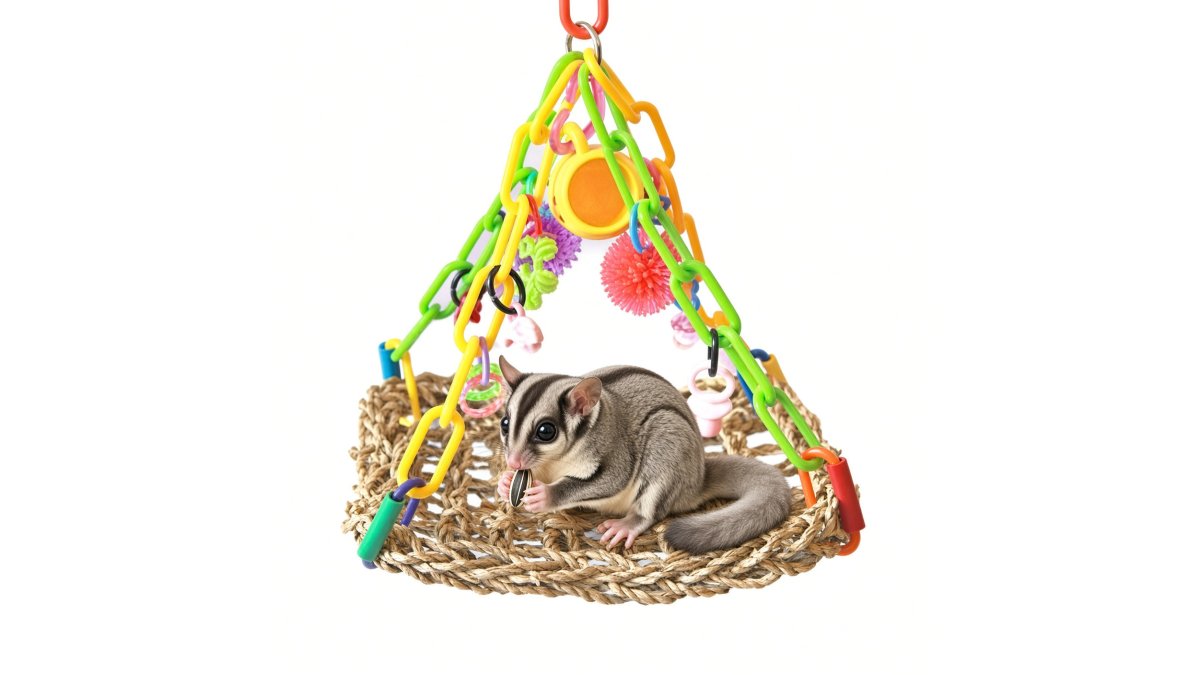
The Play Mat is a hanging seagrass mat suspended by colorful chain and decorated with beads, links, porcupine balls, and a treat cup. It works as a swing, a climbing surface, and a foraging station at once. The seagrass is edible, so a glider that chews on it is doing exactly what the toy is designed for, with no worry about what they are ingesting. At $19.95, it is the most versatile piece in the line and the one we suggest as a first purchase.

Ring a Ball Cage Toy
The Ring a Ball Cage Toy is an interactive piece built around jingling bells and colorful rings. Gliders bat at it, tug on it, and try to take it apart, which is the point. The sound rewards play and keeps them coming back. It hangs easily on most standard cages and holds up to repeated tugging. At $14.75, it is the best value in the lineup for a glider that likes noise and motion.

Disco Ball and Star Gazer
The Disco Ball catches light and throws it around the cage, which is exactly the kind of visual trigger that draws a curious glider in. The Star Gazer takes a different approach, using a colorful star design with varied textures for tugging and swinging. Both are simple hanging toys, both are easy to attach, and both cost under $13. Pair them with a foraging station and a climbing surface and you have a cage that offers three distinct kinds of play.

DIY Sugar Glider Toys You Can Build at Home
DIY sugar glider toys are worth building, provided you are strict about materials. The appeal is obvious: cheap toys, made in an afternoon, tailored to your glider. The risk is equally obvious: a homemade toy with the wrong hardware is more dangerous than a store-bought one.
Start with toy-making supplies you can verify. Untreated wood, seagrass mat offcuts, stainless steel links, solid plastic rings, and natural fleece strips for hiding pouches are all reasonable. Skip anything from a craft store bin you cannot identify, and skip anything with glue, paint, or dye.
Three projects that work well:
- The hidden treat pouch. Cut two squares of fleece, sew or knot three sides, and stuff a small amount of treat inside. Hang it with a stainless link. Gliders pull the treat out through the opening, and the fabric holds up to repeated use.
- The seagrass forage roll. Roll a strip of seagrass mat into a tube, tuck treats inside, and thread a stainless link through the center to hang it. The glider has to work the roll open to reach the food.
- The thrift store upgrade. A small untreated wooden basket from a thrift store, rinsed and dried, becomes a hanging foraging basket with two stainless links and a length of safe chain. Check for staples, glue, and splinters before it goes anywhere near the cage.
Sugar Glider Toy Rotation: A Simple Weekly Plan
Toy rotation is the single most effective enrichment habit you can build, and it costs nothing.
The logic is simple. A glider explores a new object intensely for a day or two, then ignores it. Swap that object out for one they have not seen in a week, and the exploration restarts.
Here is the weekly plan we suggest:
| Day | Action | Why It Works |
|---|---|---|
| Day 1 | Swap in 2-3 toys, remove the rest | Resets novelty |
| Day 3 | Rearrange toy positions in the cage | New routes to explore |
| Day 5 | Refresh foraging stations with new hiding spots | Re-engages food drive |
| Day 7 | Inspect all toys, clean, rotate the next set | Catches wear early |
Keep the retired toys in a box out of sight. A toy that sits in the same room stays familiar; one that disappears for a week comes back new.
Cleaning, Replacement, and Matching Toys to Temperament
Cleaning and replacement are the unglamorous half of toy ownership, and they matter as much as selection.
Replacement is a judgment call, but err early. Any toy with a broken link, a frayed strand, a loose bead, or a chewed-through component should come out immediately.
Temperament changes the recommendation more than most guides admit.
Not every toy suits every glider, and that is normal. Sugar Glider Diaries notes that while gliders may enjoy many types of toys, not all of them are required.
Frequently Asked Questions
What toys do sugar gliders like to play with?
Sugar gliders gravitate toward toys they can climb, swing on, tug apart, and explore. Hanging toys with bells, rings, beads, and varied textures hold attention longest, and foraging toys that hide a treat add a puzzle element. Exotic Nutrition notes that toys encouraging climbing, swinging, and exploring help prevent boredom and reduce stress. Keep two or three toys in the cage at a time and swap them weekly so the selection stays interesting rather than becoming furniture.
How often should you rotate sugar glider toys?
A weekly rotation works well for most households. Exotic Nutrition recommends keeping two or three toys in the cage at once and rotating them weekly. Pull the current toys out, inspect them for wear, clean them, and put a different set in. This keeps novelty high without buying new items constantly. If a glider loses interest in a toy within a day or two, shorten the cycle to every four or five days and add more foraging-style pieces.
What can I put in a sugar glider foraging toy?
Small, glider-appropriate food items work best: a mealworm, a piece of yogurt drop, a few pieces of cereal, or a sliver of fruit. The goal is a reward small enough that the glider has to work for it but not so large that it replaces the staple diet. Critter Love's Play Mat includes a treat cup that holds a small reward. Rotate the fillings so foraging stays a puzzle rather than a routine.
How can I make a simple foraging toy for a sugar glider?
Start with a small paper cup or a folded paper parcel and tuck a treat inside, then hang it where your glider can reach it. Paper is safe to shred, and the noise and tearing give the toy a second purpose. Avoid tape, staples, glue, and any small plastic piece that could come loose. Inspect homemade toys daily, since paper breaks down faster than manufactured parts, and replace them when they start falling apart.
Boredom is the quiet problem in most sugar glider cages, and it is entirely fixable. Build a small rotation, keep foraging stations loaded, and buy toys that survive real use. Critter Love® LLC makes enrichment built for gliders, including the Play Mat, Ring a Ball Cage Toy, Disco Ball, Star Gazer, and Foraging Basket, all designed to attach to standard cages and hold up to daily play. Browse the full toy line and give your gliders a cage worth exploring.


