
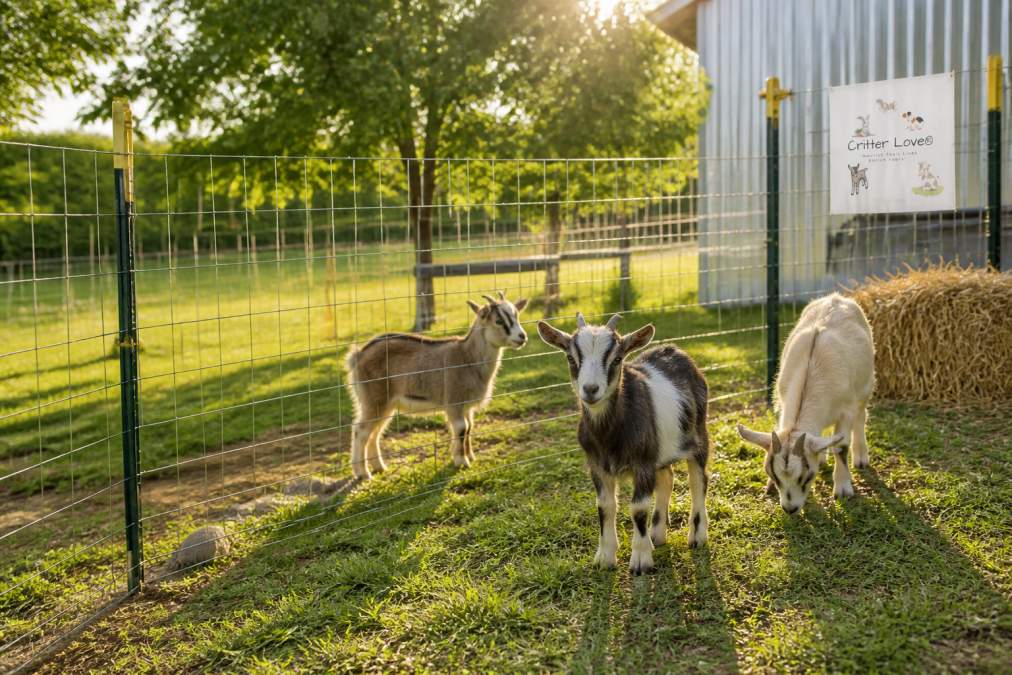
Table of Contents
- What You'll Need Before You Start
- Goat Fence Height Requirements: How Tall Is Tall Enough?
- Woven Wire Goat Fencing: The Containment Backbone
- Electric Fencing for Goats: Setup, Training, and Safety
- Step-by-Step: Installing Containment Fencing for Nigerian Dwarf Goats
- Predator-Proofing and Terrain-Specific Installation
- Maintenance Schedule and Common Mistakes to Avoid
- Frequently Asked Questions
Last Updated: September 13, 2026
What You'll Need Before You Start
Containment fencing for Nigerian Dwarf goats comes down to three numbers: height, wire gauge, and post spacing. Get them right and your herd stays put with minimal fuss.
Nigerian Dwarfs are the escape artists of the goat world: small enough to squeeze through gaps that stop full-size breeds, and smart enough to test every weak point in a fence line. This guide covers the materials, dimensions, and installation steps that actually hold them.
Before you dig a single post hole, gather these supplies:
- Fencing wire: woven wire field fence or no-climb horse fence with 2x4-inch openings
- Posts: wooden corner posts (6-8 inch diameter) and 6-foot T-posts for the line
- Bracing materials: diagonal brace posts and brace wire for every corner
- Hardware: fence staples, hog rings, tensioning tool, and insulators if running electric
- Fence charger and grounding rods for any electric strand
- Gates: at least one walk-through gate with a secure latch
- Tensioning wire for the top and bottom of the woven wire run
Budget a full weekend for a small pasture. The USDA's livestock fencing guidance for small ruminants is worth reading before you buy materials, since it covers predator pressure and local wildlife concerns that affect your wire choice.
Goat Fence Height Requirements: How Tall Is Tall Enough?
The minimum fence height for Nigerian Dwarf goats is 4 feet, but 5 feet is the safer standard, they can clear a 4-foot fence from a standing start.
Height alone doesn't stop them: a 5-foot fence with climbable surfaces nearby is just a staircase. Keep hay bales, feed troughs, water tanks, and low branches at least 3 feet back from the fence line.
Here's how height and configuration break down:
| Fence Height | Holds Nigerian Dwarfs? | Best For |
|---|---|---|
| 3 feet | No | Not recommended |
| 4 feet | Sometimes | Calm, well-fed adults only |
| 5 feet | Yes | Standard recommendation |
| 6 feet | Yes, with margin | Bucks, jumpers, predator pressure |
Bucks push harder than does, especially during breeding season. If you keep a buck, go to 5 feet minimum and add a hot wire along the top.
Woven Wire Goat Fencing: The Containment Backbone
Woven wire goat fencing is the physical barrier that does the heavy lifting. No-climb horse fence, a woven wire with 2x4-inch openings, is the top choice for Nigerian Dwarfs: the mesh prevents kids from slipping through, resists nose pressure, and stops goats from getting their heads stuck, a real risk with larger 4x4 or 6x6 field fence openings.
Wire gauge is the single spec that determines how long your fence lasts. Gauge works inversely: the lower the number, the thicker the wire. A 12.5-gauge wire holds its shape for years; a 14-gauge wire deforms the first time a goat leans on it. Heavier wire costs more and takes longer to stretch, but it outlasts cheap fencing by a wide margin.
Here is how the common gauges compare for a Nigerian Dwarf perimeter:
| Gauge | Wire Diameter (approx.) | Coating | Best Use | Durability Under Goat Pressure |
|---|---|---|---|---|
| 12.5-gauge | ~0.099 in | Class 3 zinc | Permanent perimeter | 15-20+ years |
| 14-gauge | ~0.080 in | Class 1 or 3 zinc | Interior dividers, temporary runs | 8-12 years |
| 16-gauge | ~0.062 in | Class 1 zinc | Low-pressure or short-term use | 3-6 years |
| 17-gauge | ~0.058 in | Class 1 zinc | Not recommended for goats | 2-4 years |
| 20-gauge | ~0.035 in | Light zinc | Garden/deer only | Under 2 years |
Two specs beyond gauge deserve equal weight. Coating class: Class 3 zinc roughly doubles wire life versus Class 1, because the zinc corrodes before the steel does. Knot type: fixed-knot woven wire holds its mesh shape under pressure, while hinge-joint (stiff-stay) wire flexes and recovers, more forgiving on uneven ground but slightly less rigid against a determined goat.
For a permanent Nigerian Dwarf perimeter, the practical target is 12.5-gauge, Class 3 coated, fixed-knot no-climb with 2x4 openings, it resists nose pressure, prevents kid escape, and won't need replacing for well over a decade. A 14-gauge, Class 1 roll saves money up front and costs more in re-stretching and eventual replacement.
- 12.5-gauge: thick, stiff, resists deformation, best for permanent perimeter
- 14-gauge: mid-weight, fine for interior dividers, sags faster under pressure
- 16-gauge: light, easy to work with, only suitable for temporary or low-pressure use
Electric Fencing for Goats: Setup, Training, and Safety
Electric fencing for goats works as a psychological barrier rather than a physical one, and it's the most effective addition to a woven wire perimeter. One or two strands of hot wire on insulators teach goats that the fence bites.
Setup follows a simple pattern:
- Run a hot wire along the top of the woven wire at nose height, roughly 10 to 12 inches above the wire's top edge.
- Add a second strand at 10 to 12 inches off the ground to stop goats from pushing underneath.
- Drive a minimum of three grounding rods, spaced 10 feet apart, near the charger.
- Connect the charger to a power source and test the line with a fence tester before turning animals out.
Training takes about a week. Confine new goats to a small, hot-wired paddock so they meet the wire in a controlled space. Most learn after one or two encounters. A goat that respects the wire in a small pen generally respects it on the full perimeter.
The USDA National Wildlife Research Center's predator and fencing [resources(/pages/resources) | usda.gov] notes that electric strands also deter many predators, which makes them worth running even if your goats are already well-behaved.
Step-by-Step: Installing Containment Fencing for Nigerian Dwarf Goats
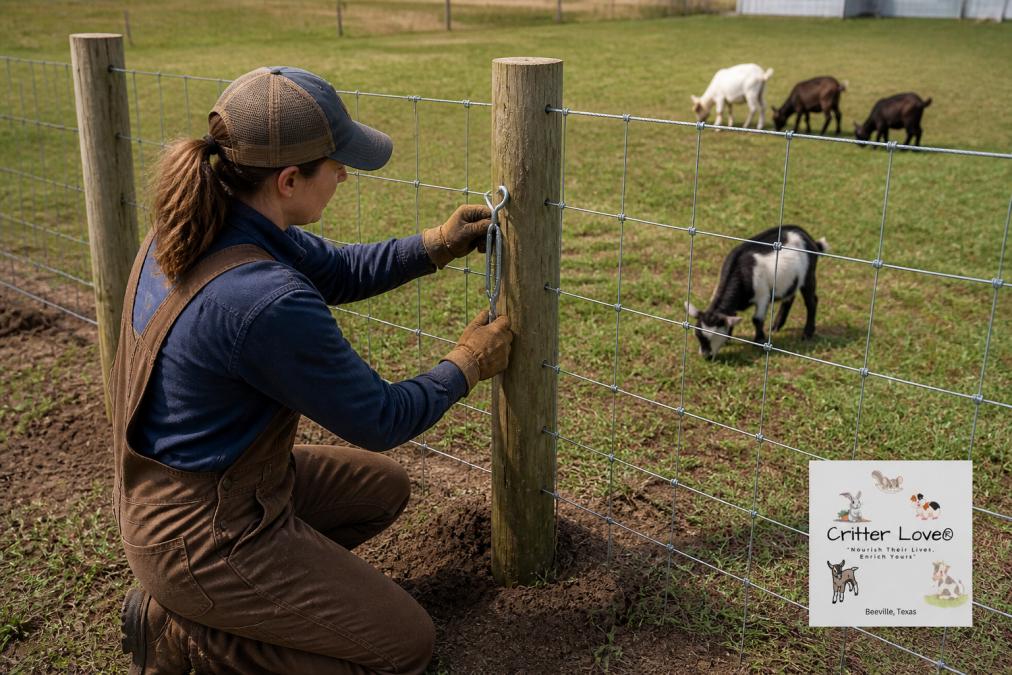
Installation follows a set sequence: corners first, then the line, then the wire, and finally the electric.
- Set corner and end posts. Dig holes 2 to 3 feet deep, set 6 to 8-inch wooden posts, and brace every corner with a diagonal brace.
- Drive line posts. Space T-posts every 8 to 10 feet along straight runs; tighten to 6 to 8 feet on curves or slopes.
- Unroll and stretch the woven wire. Attach one end at a corner, pull the wire taut with a tensioning tool, and secure it to the far corner before fastening to line posts.
- Fasten the wire. Use fencing staples on wooden posts and wire clips or hog rings on T-posts. Fasten every post, not every other one.
- Install gates. Hang gates so they swing freely and latch securely. A goat can open a loose latch with its nose.
- Run the electric strands. Add insulators to T-posts and string hot wire at the heights noted above.
- Ground and test. Drive grounding rods, connect the charger, and test the entire run with a fence tester before turning goats out.
Post spacing on sloped ground should tighten to 6 feet. Wire that spans too far on a grade sags in the middle, and a sagging bottom edge is an open invitation.
Predator-Proofing and Terrain-Specific Installation
Predators attack from two directions: over the top and under the bottom. Coyotes, foxes, and neighborhood dogs dig; some climb. A goat fence that stops goats but ignores predators is only half a fence.
Closing the digging gap
The apron is the single most effective predator defense. Bury a 12 to 18-inch skirt of woven wire flat along the outside base of the fence, then backfill over it; a digging predator hits the buried wire and cannot tunnel under. Alternatives include:
- L-shaped apron on the surface: lay the skirt flat on top of the ground and pin it with landscape staples, then cover with soil or gravel. Easier where digging is impractical.
- Buried bottom edge: trench the woven wire itself 6 to 12 inches into the ground. Works on soft soil but fails on rock.
- Electric offset wire: a single hot strand 6 to 8 inches off the ground, offset 6 to 8 inches outside the fence line, delivers a nose-level shock to anything investigating the base.
Closing the climbing gap
A single hot strand along the top edge discourages climbing predators and jumping goats at once. Mount it on insulators 6 to 8 inches above the woven wire's top rail, so coyotes and dogs that scramble over meet the wire before they commit.
Securing gates and openings
A latch that requires two motions, a chain plus a snap, or a double-ended gate latch, stops both goats and raccoons, which open single-motion latches within days. Any gap wider than 2 inches at a gate post is an escape route; back it with a welded wire panel or a second post.
Terrain-specific installation
Flat ground is the easy case. Most homesteads are not flat, and the standard advice to "space posts every 8 to 10 feet" breaks down on slopes, rock, and sand.
Slopes. Step the fence in short panels rather than stretching wire across a grade, and tighten post spacing to 6 feet. Add a hot wire at the low side where animals naturally press. On steep ground, consider hinge-joint knots, which flex with the terrain instead of kinking.
Rocky ground. Where you cannot drive T-posts, use drilled rock anchors with expansion bolts, or heavy wooden posts set in concrete. Corner and end posts carry the most load, so spend the extra effort there: drill a 1-inch hole 6 to 8 inches deep, epoxy a threaded rod, and bolt the brace to it.
Sandy soil. Sand offers little lateral resistance, so set corner posts 3 to 4 feet deep with a concrete collar and brace in two directions. Line posts may need to be driven deeper or set in concrete too, a fence that stands in clay will lean in sand without these adjustments.
Wet or low ground. Posts rot faster and frost heave pushes them up. Use pressure-treated posts rated for ground contact, and set them below the frost line where that applies. Re-check the line every spring after the thaw.
Maintenance Schedule and Common Mistakes to Avoid
A goat fence is a system that needs a walk-through, not a one-time build. Most failures trace back to a few avoidable mistakes.
| Frequency | Task |
|---|---|
| Weekly | Walk the perimeter; look for sagging wire, loose staples, and fresh digging |
| Monthly | Test the electric line with a fence tester; check the charger and grounding rods |
| Seasonally | Re-tension wire, clear vegetation from the electric strand, re-check gate latches |
| After storms | Inspect for downed limbs, shifted posts, and damaged wire |
The mistakes that cost the most time:
- Underestimating height. A 4-foot fence looks adequate until a goat proves otherwise.
- Leaving climbable objects near the line. Feeders, water troughs, and stacked hay become launch pads.
- Weak gate latches. Goats learn to work simple latches within days.
- Poor grounding. A charger without proper grounding delivers a weak pulse that goats learn to ignore.
- No apron wire. Digging predators enter under a fence that's otherwise goat-proof.
If you're sourcing animals to go with your new fence, Critter Love® LLC offers healthy Nigerian Dwarf goats.
Frequently Asked Questions
What is the best fencing for Nigerian Dwarf goats?
Woven wire fencing with 2x4-inch openings, paired with a hot wire at nose height, is the most reliable containment for Nigerian Dwarf goats. This combination prevents them from squeezing through gaps and discourages climbing. No-climb horse fence is a popular choice because the small mesh stops horns from getting stuck. For added predator protection, bury the bottom of the wire 6 inches underground or add an apron.
How tall of a fence do Nigerian Dwarf goats need?
A minimum of 4 feet is required, but 5 feet is safer for Nigerian Dwarf goats because they are agile jumpers and climbers. Goat fence height requirements also depend on whether they have nearby surfaces to launch from. Keep feeders, water troughs, and hay bales at least 3 feet away from the fence line to remove launch points. If your goats are escape artists, consider adding a top rail or angling the top of the fence inward.
Is electric fencing safe for Nigerian Dwarf goats?
Yes, electric fencing for goats is safe when installed correctly with a UL-listed fence charger and proper grounding. The brief pulse deters without injury. Use a charger rated for the fence length, and place the hot wire at nose height (about 12 to 15 inches for adults) so goats learn to avoid it. Always train goats to the fence before leaving them unsupervised, and check that the charger is working with a fence tester.
How do you prevent Nigerian Dwarf goats from climbing fences?
Prevent climbing by removing climbable surfaces near the fence, such as stumps, rocks, or low shelters. Install a hot wire along the top rail to discourage leaning and jumping. Woven wire goat fencing with small openings also makes it harder for hooves to find purchase. Some owners add a strand of electric wire 6 inches inside the fence line as a secondary barrier. Consistent training and adequate browsing space reduce boredom-driven escapes.
Building a fence that holds Nigerian Dwarf goats means matching height, wire gauge, post spacing, and electric strands to the animals and the land. It's a weekend of work that prevents months of chasing. Critter Love® LLC helps homesteaders get the animals and the know-how to keep them safe, with a live animal arrival guarantee, shipping within 24 business hours, and over 10,000 customers who trust the same guidance. Get started with Critter Love® LLC and build a perimeter that holds.


