
Table of Contents
- Why Nigerian Dwarf Goats Warm Up at Different Speeds
- Before You Start: What You'll Need and How to Set Up the Pen
- Step 1: Sit Quietly in the Pen and Let Them Approach
- Step 2: How to Befriend a New Goat With Hand-Feeding
- Step 3: How to Get a Baby Goat to Like You
- Step 4: How to Socialize an Unsocialized Goat (Adults and Rescues)
- Step 5: Reading Body Language, Gentle Handling, and Child Safety
- Step 6: Goat Enrichment and Play That Builds Confidence
- Frequently Asked Questions
Last Updated: October 13, 2026
Why Nigerian Dwarf Goats Warm Up at Different Speeds
Learning how to socialize nigerian dwarf goats starts with one truth: there is no single timeline. Nigerian Dwarf goats are a small breed known for a curious, friendly temperament, but how fast a goat trusts you depends on its history. A bottle-raised kid may climb into your lap on day one; a dam-raised kid from a closed herd may need weeks.
At Critter Love® LLC, we raise Nigerian Dwarf goats and see the same pattern every time: goats that met many gentle humans early settle in fast, while goats that did not need patient, repeated contact.
Age matters, but so does breed temperament, Nigerian Dwarfs are naturally bold for their size. Still, a shy goat is not a broken goat; it simply has not yet learned people are safe.
Below, we break socializing into six steps, from sitting quietly in the pen to reading stress signals. Most goats progress within a few weeks of steady, low-pressure contact.
Before You Start: What You'll Need and How to Set Up the Pen
A calm setup does more for bonding than any trick. Goats relax when they have space to retreat, so build a pen with a quiet corner the goat can reach without passing you.
Here is what to have ready:
- A small, secure pen with a low-traffic corner
- A stool or bucket to sit on, so you are at goat height
- High-value treats in a small bucket
- A loose lead and a brush for later handling
- A helper for child supervision, if kids are involved
Keep the first sessions short. Ten to fifteen minutes is plenty. Goats get bored and wary fast, and a bad session sets you back more than a good one moves you forward.
Check your goat's health first: a goat that feels off will act skittish no matter how gentle you are. Before any new goat joins your farm, ask the seller for vet checks, vaccination records, and pedigree tracking, that paperwork tells you far more about temperament history than a quick look in the pen.
Step 1: Sit Quietly in the Pen and Let Them Approach
The fastest way to befriend a new goat is to stop trying so hard. Sit down inside the pen, stay still, and let the goat come to you, chasing teaches it that people are a threat.
Bring a book or your phone. Ignore the goat on purpose. Nigerian Dwarfs are nosy, and curiosity beats fear most days. Within a few sessions, most will edge closer to sniff your boots.
Always leave a clear path so the goat can walk away. A goat that feels trapped will bolt, and bolting undoes days of work.
Repeat this daily, same time, same spot, same stillness. Predictability builds trust.
Step 2: How to Befriend a New Goat With Hand-Feeding
Food turns a cautious goat into a bold one. Once your goat approaches within a few feet, offer a treat from a flat, open palm and hold still.
A few rules keep hand-feeding safe and effective:
- Use small, high-value treats, not a full meal
- Keep your hand flat and low, below the goat's eye line
- Never grab or pet while the goat eats
- Pair every treat with a soft, low voice
Animal crackers and plain oats work well for most goats. Feed a few pieces, then stop. Ending on a good note leaves the goat wanting more.
This is the step where "how to befriend a new goat" stops being theory. Hand-feeding creates a positive association: you equal good things. That link is the foundation for everything that follows.
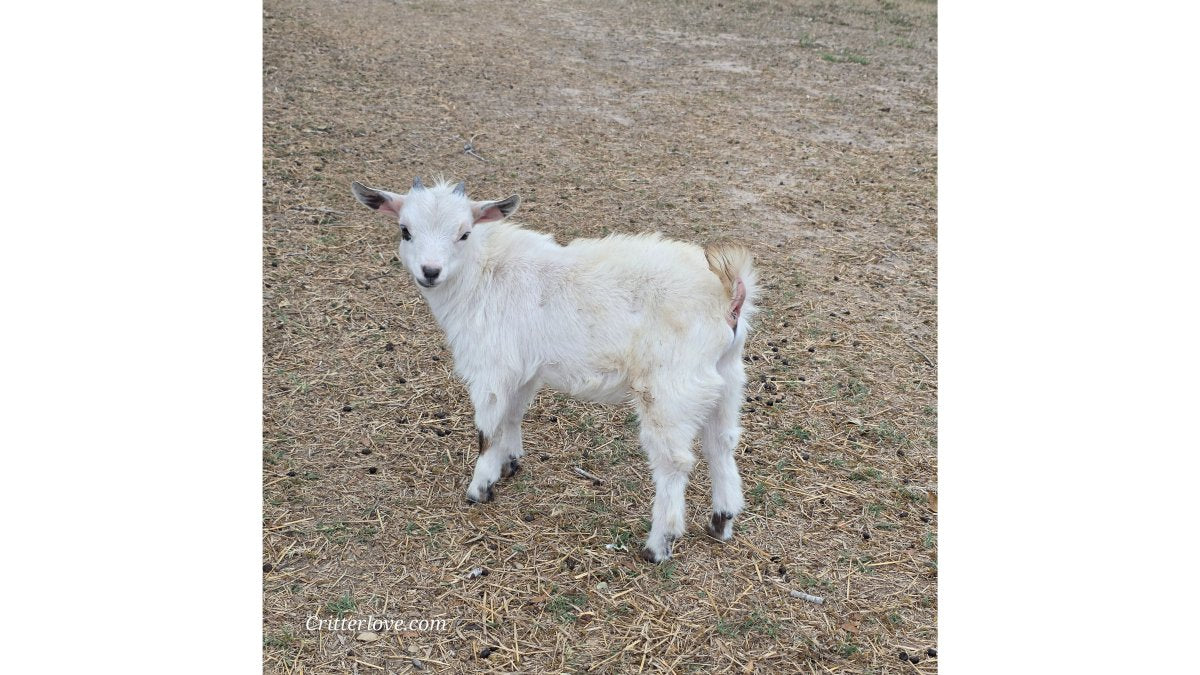
Nigerian Dwarf Buckling (Mainly white) →
Step 3: How to Get a Baby Goat to Like You
Baby goats, or kids, bond fastest of all, but the biggest variable is how they were raised. A bottle-raised kid learned early that humans bring food and comfort; a dam-raised kid learned that its mother and the herd are the safe zone.
Here is a gradual plan that works for either background. Treat each stage as a checkpoint, not a deadline.
Days 1-3: Presence only. Sit on the ground inside the pen for 10-15 minutes, twice a day, and do not reach for the kid. Let it circle you, sniff your boots, and retreat.
Days 4-7: Curiosity and approach. Once a kid steps within a few feet on its own, keep your hands still and low and let it nibble your shoelace or bump your knee.
Week 2: Hand-feeding and brief touch. Offer a small treat from a flat, open palm below the kid's eye line.
Week 3 and beyond: Handling and lift practice. Nigerian Dwarf kids are small enough to lift, which is both an advantage and a risk.
A few things speed the process up:
- Sit on the ground so you are not towering over them
- Let kids climb on you, but keep movements slow
- Talk softly and avoid sudden noises
- Handle them briefly, then let them go
- Keep a companion kid or the dam within sight during early sessions
Bottle-raised kids often bond to people within days; dam-raised kids take longer because their first trust went to the herd.
Keep sessions short and fun. A kid that associates you with play and treats will follow you around the pen in no time, and grows into an adult that stands calmly for hoof trimming instead of bolting.
Step 4: How to Socialize an Unsocialized Goat (Adults and Rescues)
Adult and rescued goats need the slowest approach of all. When you socialize an unsocialized goat, expect weeks, not days, sometimes months.
Stage 1: Presence (week 1-2). Sit in the pen and do nothing, as in Step 1, but for 20 to 30 minutes once or twice a day.
Stage 2: Distance feeding (week 2-3). Once the goat resumes normal behavior, grazing, chewing cud, moving around, toss a treat a few feet away, then closer over time.
Stage 3: Proximity (week 3-5). Sit nearer the food bowl while the goat eats, and do not reach.
Stage 4: Hand-feeding (week 5+). Offer a treat from a flat, open palm only when the goat stays calm at close range.
Stage 5: First touch. Add a brief touch on the shoulder, then stop. One second is enough at first.
Nigerian Dwarf-specific notes. Their small size makes them easier to handle than a full-size goat, but a frightened adult can be cornered more easily.

Some rescued goats never become lap goats. That is fine. A goat that eats calmly near you and follows you around the pen is a win.
Nigerian Dwarf Buckling (Mainly white) →
Step 5: Reading Body Language, Gentle Handling, and Child Safety
Goats tell you how they feel before they act. Learning their signals keeps everyone safe and speeds bonding.
Calm signs:
- Soft, relaxed ears and a loose tail
- Chewing cud near you
- Stepping toward you out of curiosity
Stress signs:
- Stiff body and a raised tail
- Wide eyes and a quick bolt away
- Head lowered with a direct stare, which is a threat warning
When you see stress signs, back off. Pushing through fear teaches the goat that people do not listen.
For gentle handling, approach from the side, not head-on. Rest a hand on the shoulder before petting. Keep touches brief at first.
Children need clear rules: a goat the size of a large dog can knock a small child down without meaning to. Teach kids to sit still, use quiet voices, and never chase, and always supervise. Goats and kids make a great pair, but only with a grown-up nearby.
Step 6: Goat Enrichment and Play That Builds Confidence
Goat enrichment and play do more for socialization than most owners expect. A bored goat is a wary goat; a busy, curious goat explores, and exploring brings it closer to you.
Try adding:
- Climbing spools or sturdy platforms
- A treat ball or puzzle feeder
- Low branches to browse on
- New objects to sniff, rotated weekly
Play also lowers stress. A goat that plays near you trusts you, so sit nearby while they climb and explore, and let them come to you for a scratch.
Keep the herd together when you can, goats are herd animals, and a lone goat is a stressed goat. Let the group settle as a unit rather than pulling one goat away for solo sessions.
Progress is not always a straight line. A goat that was friendly last week may shy away after a storm or a vet visit. Give it time. Consistency wins.
Socializing Nigerian Dwarf goats takes patience, but the payoff is a herd that seeks you out instead of running. If you are ready to add friendly, well-started goats to your farm, Critter Love® LLC can help. We offer Nigerian Dwarf goats with a live animal guarantee, vet checks and pedigree tracking on every animal. Our team is here to answer questions before and after you buy.
Frequently Asked Questions
How long does it take to socialize a shy or unsocialized goat?
There is no fixed timeline. A bottle-raised kid may climb into your lap within days, while a dam-raised or rescued adult can take weeks or months of short, calm sessions. Work in 10 to 15 minute visits once or twice a day and let the goat set the pace. If your goat stops eating treats, backs away, or freezes, end the session and try again tomorrow. Progress shows up as smaller reactions: less bolting, more standing still, and eventually approaching you first.
How do I get a baby goat to like me without scaring it?
Sit low, stay quiet, and let the kid come to you. Offer a high-value treat from a flat palm, such as a small piece of animal cracker, and avoid reaching over its head or grabbing it. Spend time near the herd so the kid feels safe. Short, frequent visits work better than one long session, and gentle scratching under the chin or on the chest usually lands better than a full-body hug at first.
Can an adult goat become friendly if it was never socialized as a kid?
Yes, though it takes longer. Adult goats that were dam-raised, rescued, or kept in a large herd often see people as a threat at first. Use the same steps you would with a kid: sit quietly, hand-feed treats, avoid chasing, and let the goat approach. Pairing the work with a calm companion goat helps, because goats take cues from herdmates. Some adults stay reserved and simply tolerate handling, which is still a good outcome.
What treats and enrichment do Nigerian Dwarf goats like best?
Goats respond well to small amounts of animal crackers, a few raisins, or a handful of hay pellets, given by hand rather than tossed on the ground. For enrichment and play, try sturdy climbing spools, a spool or stump to jump on, hanging branches, and a treat ball that rolls out rewards. Rotate items every week or two so the pen stays interesting, and always keep loose wire, twine, and plastic bags out of reach.


